
Updated June 30, 2025 · 4 min read · By Capt. Mark Walton FRAeS
Overview
When we think about runway contamination, regulatory standards and operational procedures tend to focus on water, snow, slush, and ice. These have long been understood, modelled, and incorporated into aircraft performance data and certification standards.
However, one significant class of contaminants remains largely unaddressed in current certification frameworks: non-liquid contaminants such as sand, dust, volcanic ash, and rubber build-up.
Despite being regularly encountered in many regions around the world, particularly in desert, arid, and volcanic environments, these contaminants are not formally accounted for in the performance data supplied by manufacturers, nor are they specifically addressed in certification specifications such as EASA’s CS-25 or the FAA’s Part 25 rules. That omission has operational consequences.
For a deeper technical analysis, see:🔗 SSRN Working Paper on Non-Liquid Runway Contamination
Current Certification Standards: What’s Missing?
Aircraft takeoff and landing performance is certified using defined runway conditions. These include:
Certification standards require manufacturers to validate stopping distances and control characteristics for these defined conditions. However, no formal requirement exists to test or model aircraft performance on surfaces contaminated by sand, volcanic ash, or rubber accumulation. All of these can have a substantial impact on braking action, especially during the landing rollout.
- Dry
- Wet
- Contaminated (with ice, snow, or slush)
Why It Matters: A Hidden Hazard
Non-liquid contaminants pose a unique threat because their effects are both subtle and unpredictable:
Many operators flying in regions affected by seasonal dust storms or volcanic activity develop informal mitigation strategies. These are often reactive, based on experience, and lack standardized support from OEMs or regulators.
- Reduced Braking Action: Sand and ash can dramatically increase landing distances. Unlike snow or standing water, these effects are often not visible from the cockpit or detectable by onboard sensors.
- Lack of Performance Guidance: Crews receive no adjusted performance data or regulatory guidance for non-liquid contaminants. Landing distance assessments may be based on overly optimistic assumptions.
- False Sense of Security: A runway may appear “dry” or “bare,” leading to normal landing assumptions, while in reality, a fine layer of dust or rubber can produce hydroplaning-like effects.
Operational Implications for Flight Crews
Given the current regulatory gap, crews must take a proactive and conservative approach when operating into airports where non-liquid contamination is suspected:
1. Review NOTAMs and local weather patterns for indicators of recent sandstorms, volcanic activity, or rubber build-up due to high-traffic operations.
2. Apply additional safety margins to landing distance calculations when operating in suspect conditions.
3. Report braking action and anomalies consistently to ATC and the operator’s safety team to improve shared awareness and hazard recognition.
A Strategic Note for Airline Operators
For operators, the absence of formal certification standards does not remove the responsibility to assess and manage this operational risk. Non-liquid contamination can and should be proactively addressed through internal safety programs.
For more on BACF, see:🔗 Airbus NAVBLUE – Braking Action Computation Function (BACF)
By using available data tools and operational feedback, operators can improve awareness and resilience ahead of any regulatory changes.
- Use tools such as BACF and Flight Data Monitoring (FDM) systems critically. While these systems may not model non-liquid contaminants explicitly, they show the actual braking action that an aircraft experienced and thus can demonstrate in real time or as part of a study why a safety case needs to be made.
- Identify trends in rollout distance, braking performance, and anomaly reports. These data points, when correlated with environmental conditions, can help identify hidden hazards.
- Develop internal policy and guidance that reflects the realities of operating in regions prone to dust, ash, or rubber accumulation. This might include performance margin adjustments, conditional dispatch limitations, or specialized pilot briefings.
A Call for Regulatory Attention
The industry cannot continue to treat sand, ash, and rubber as incidental or non-hazardous simply because they are dry. The science, supported by incident data and field observations, clearly shows that these contaminants can compromise braking performance just as significantly as wet or icy conditions.
It is time for certification authorities, aircraft manufacturers, and safety regulators to recognize non-liquid runway contamination as a distinct operational threat. Doing so would pave the way for:
- New performance testing requirements
- Updated pilot training and guidance
- More accurate runway condition reporting
Conclusion
Until such changes are implemented, awareness remains our most powerful tool. As flight crews, instructors, and safety professionals, we must recognize that the absence of regulatory language does not mean the absence of risk. By treating non-liquid contaminants with the seriousness they warrant, we can reduce the likelihood of runway excursions and protect safety margins.
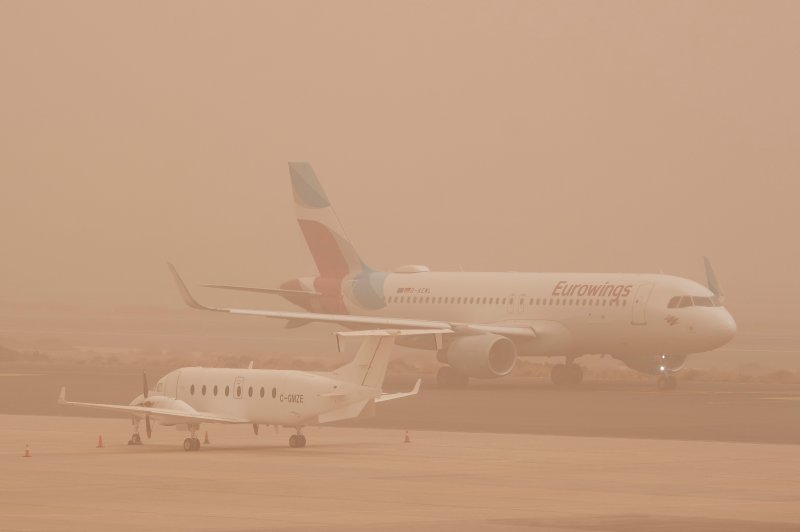
An Airbus A320 of Eurowings during a sandstorm event
When Lessons Fade: The Tragedy of D-AXLA and the Importance of Respecting Maintenance Check Flights
Airbus A320 PFD and ND
Comparative Analysis of Aviation Decision-Making Models: Optimizing Cognitive Strategy and Operational Judgment
Work on this one-to-one
Briefing, A320 full motion simulator session, assessment preparation and structured debrief so you fly your airline simulator assessment to the standard assessors expect.