
Updated May 25, 2025 · 6 min read · By Capt. Mark Walton FRAeS
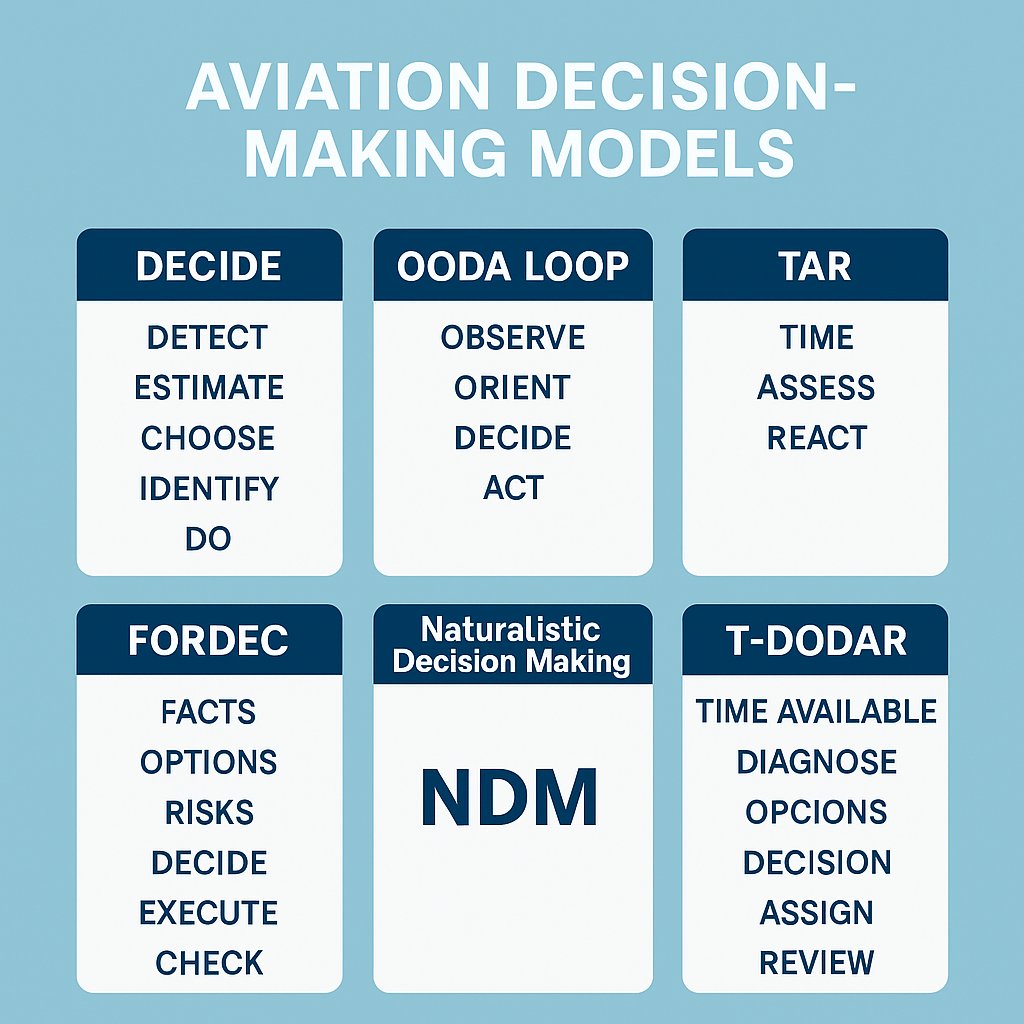
Overview
Abstract:
Effective decision-making in aviation is foundational to the mitigation of operational risk and the assurance of flight safety. In the context of high-consequence, high-complexity flight environments, structured cognitive frameworks offer a mechanism by which pilots may systematize threat recognition and adaptive response. This article provides an advanced comparative analysis of seven established decision-making models utilized in aviation: DECIDE, OODA Loop, FORDEC, TAR, Naturalistic Decision Making (NDM), DODAR, and its time-sensitive variant T-DODAR. These frameworks are evaluated against criteria including cognitive demand, temporal adaptability, collaborative utility, and contextual robustness. The discussion advances a pedagogical and operational perspective on integrating these models into evidence-based training (EBT) and failure management paradigms.
1\. Introduction
The exercise of aeronautical decision-making (ADM) is not merely an operational competency but a cognitive discipline shaped by environmental variability, procedural complexity, and human performance limitations. Pilots routinely navigate ambiguous and fluid operational environments wherein time pressure, incomplete data, and system malfunctions necessitate calibrated judgment. Consequently, aviation psychology and training philosophy have evolved to incorporate formalized decision-making models that support pilot cognition during both routine and abnormal operations. This analysis contextualizes seven principal models and interrogates their applicability to contemporary airline training and operational environments.
2\. Decision-Making Models in Aviation
2.1 The DECIDE Model
Originating from FAA human factors research, the DECIDE model represents a prescriptive, stepwise framework primarily intended for novice or ab initio pilot cohorts:
\- Detect a change
\- Estimate the need for action
\- Choose the optimal outcome
\- Identify viable actions
\- Do the selected action
\- Evaluate the effect of that action
Strengths:- Facilitates structured, rational analysis- Pedagogically effective for cognitive scaffolding
Limitations:- Poor adaptability under high time pressure- Linear rigidity may limit responsiveness in dynamic environments
2 The OODA Loop
Conceived by military strategist Col. John Boyd, the OODA Loop (Observe–Orient–Decide–Act) promotes recursive situational reassessment and tempo agility in volatile operational theatres.
Strengths
- Promotes continuous feedback and cognitive flexibility
- Useful in time-critical or ambiguous environments
Limitations
- Lacks explicit structure for group coordination
- Assumes high baseline situational awareness and experience
3 FORDEC
Widely adopted in European airline training, FORDEC enhances CRM integration and team-based analysis:
- F acts
- O ptions
- R isks
- D ecide
- E xecute
- C heck
Strengths
- Explicitly integrates risk analysis
- Supports CRM through task transparency and dialogue
Limitations
- Less suitable for acute, high-tempo scenarios
- Can become procedurally rote if not applied contextually
TAR
functions as a minimalist model tailored for extreme time constraints, providing a heuristic alternative when procedural depth is unfeasible.
Strengths
- High utility in unstable approach scenarios or rapidly deteriorating system states
- Supports mental prioritization and timely response
Limitations
- Lacks granularity for complex decisions
- Not conducive to shared decision-making
NDM
posits that experienced operators draw from mental schema, intuition, and pattern recognition developed through accumulated domain exposure.
Strengths
- Reflective of expert-level cognitive behavior
- Highly relevant in unstructured or novel events
Limitations
- Not teachable in conventional pedagogical formats
- Risks reliance on undocumented heuristics
6 DODAR
The DODAR model (Diagnose–Options–Decide–Assign–Review) is prominent in abnormal scenario management and aligns well with checklist-structured airline operations.
Strengths
- Facilitates collaborative task distribution
- Enhances CRM via explicit delegation and review
Limitations
- Presupposes moderate time availability
- Temporal limitations are not explicitly encoded
T-DODAR
integrates temporal appraisal as its initiating step, thereby contextualizing the entire decision architecture based on urgency:
- T ime available
- D iagnose the issue
- O ptions development
- D ecision selection
- A ssignment of crew actions
- R eview of implementation
Why It Matters
The inclusion of time assessment enables cognitive and procedural calibration. By appraising time constraints from the outset, pilots can adjust the breadth and pace of subsequent decision steps. For instance, in scenarios involving an uncontrolled fire, fuel leak, or engine fire on short final, T-DODAR prompts expediency and decision narrowing. Conversely, greater temporal bandwidth permits expanded crew consultation and option analysis.
Strengths
- Harmonizes decision strategy with operational tempo
- Fosters CRM through task assignment and iterative review
Limitations
- Dependent on active crew communication discipline
- Risks being overlooked under stress without training reinforcement
Decision-Making Models in the Context of Failure Management
Effective failure management transcends reactive troubleshooting; it entails anticipatory planning, collaborative strategy, and dynamic risk assessment. Decision-making models provide a metacognitive infrastructure to address failure events systematically.
These frameworks should be reinforced in simulator scenarios and LOFT exercises to cultivate not only procedural compliance but cognitive resilience and operational foresight.
- Identification and Framing: DECIDE and DODAR provide scaffolding for accurate problem diagnosis.
- Urgency Modulation: T-DODAR excels in calibrating response intensity to time availability.
- Option Differentiation: FORDEC and OODA encourage comparative evaluation of strategies in real time.
- Collaborative Load Management: DODAR and T-DODAR embed delegation mechanisms that mitigate overload and sustain crew cohesion.
- Outcome Monitoring: The “Review” or “Check” stages ensure feedback loops, enabling adaptive corrections and post-event learning.
Why T-DODAR Deserves Emphasis – Author Perspective
Among the structured decision-making models available to pilots, T-DODAR offers a distinctive and operationally practical advantage: it front-loads time awareness into the decision process.
As the author of this article who is a Chief Pilot senior airline training captain, I support T-DODAR for the following reasons:
1. It aligns decision tempo with situation urgency.
Traditional models assume a linear process regardless of time pressure. T-DODAR begins by asking:
“Do we have 30 seconds or 30 minutes to decide?” This changes everything. If the situation is time-critical \- such as an uncontrolled fire, low-fuel state/fuel leak, or engine fire on short final - crew members can quickly narrow options, prioritize essentials, and react without delay. Conversely, if time allows, a more comprehensive option analysis can follow.
2. It prevents “paralysis by analysis” in the heat of the moment.
By establishing the time frame first, T-DODAR eliminates the risk of crews getting stuck in overly analytical thinking when time does not permit it.
3. It builds in a CRM framework through task assignment and review.
Like FORDEC and DODAR, T-DODAR reinforces crew coordination, but its emphasis on urgency enhances shared situational awareness and workload distribution.
4. It’s flexible and intuitive, yet still trainable.
T-DODAR strikes a balance between procedural structure and adaptive reasoning. This makes it a valuable tool for both ab initio and experienced pilots, particularly within Evidence-Based Training (EBT) and scenario-based simulation.
Conclusion to Author Perspective
In aviation, the tempo of decision-making is as important as the decision itself. T-DODAR gives pilots the cognitive discipline to act appropriately for the time available. It trains them to ask the right question first:
“How much time do we really have?”
This single prompt can be the difference between an effective resolution and a mismanaged emergency.
For this reason, T-DODAR deserves greater integration into initial and recurrent pilot training programs, especially in multi-crew airline environments where time pressure and teamwork often collide.
References
European Union Aviation Safety Agency (EASA). Evidence-Based Training Guidance Material.
Aviation Decision Making Models
When Lessons Fade: The Tragedy of D-AXLA and the Importance of Respecting Maintenance Check Flights
The Overlooked Threat: Non-Liquid Runway Contamination and the Gap in Certification Standards
Airbus A320 PFD and ND
- Flin, R., O’Connor, P., & Crichton, M. (2008). Safety at the Sharp End: A Guide to Non-Technical Skills. Ashgate.
- Federal Aviation Administration. (2009). Pilot’s Handbook of Aeronautical Knowledge.
- Klein, G. (1998). Sources of Power: How People Make Decisions. MIT Press.
- Civil Aviation Authority. (2021). Human Factors in Aviation – CAA Paper 2021/01.
Work on this one-to-one
Briefing, A320 full motion simulator session, assessment preparation and structured debrief so you fly your airline simulator assessment to the standard assessors expect.